

Nettify Hotel Network Design — Wi-Fi Built for Hospitality
Network topology, access point placement, hardware specification, brand standards compliance, and future-proofing for IPTV, casting, and digital signage. For new builds and redesigns.
A hotel network is not an office network. It needs to handle hundreds of guest devices per floor, deliver reliable IPTV and casting to every room, separate guest traffic from hotel operations — physically where brand standards require it — and do it all without dead zones in corridors, pool areas, or basement meeting rooms.
A Nettify hotel network design starts from the property — its layout, its building materials, its service ambitions — and produces a complete infrastructure plan with topology, access point placement, hardware specification, and brand standards documentation. Whether you are building from scratch or redesigning after an audit, the result is a network that works on opening day and scales for whatever comes next.
Every hotel network design starts with one question — what are you building?
The design works for both new builds and refurbishments, and adapts to where you are today.
New Build or Major Renovation
You have floor plans but no network yet — or the property is being gutted and rebuilt. This is the ideal starting point: the network is designed alongside the building, not retrofitted after the fact.
Cabling routes, equipment locations, AP mounting points, and power requirements are all planned before the first wall goes up. The design accounts for every service the hotel will run — Wi-Fi, IPTV, casting, signage, PMS integration — from day one.
Existing Property Redesign
The hotel is operational but the network no longer meets demand — guest complaints, new services like IPTV or casting, or a failed vendor deployment. A redesign works within the existing building constraints.
If a Wi-Fi audit has already been completed, the design builds directly on those findings. If not, a site assessment is included as part of the design engagement to ensure accuracy.
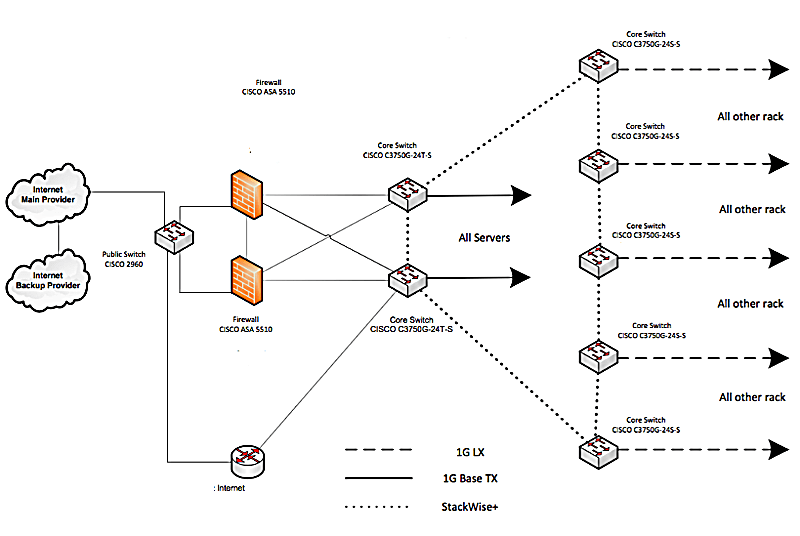
Example: Single-line network topology diagram for a multi-building hotel property
What does a Nettify hotel network design deliver?
A complete infrastructure plan — not a generic schematic, but a design built around your property, your services, and your brand.
Network Topology & Architecture
The backbone of the design — core, distribution, and access layers mapped to your property's physical layout. Defines switch stacking, uplink redundancy, ISP failover paths, and the logical structure that everything else connects to. Delivered as a single-line diagram (SLD) with full documentation.
Access Point Placement Plan
Every AP location specified on the floor plan — with channel assignment, power level, and mounting type. Accounts for building materials (concrete, glass, timber), guest density per zone, and coverage overlap to ensure continuous roaming between rooms, corridors, lobbies, and outdoor areas.
Hardware Specification & BoM
A vendor-neutral Bill of Materials listing every component — switches, access points, controllers, patch panels, cabling, racks, and power infrastructure. Specifies models and quantities without locking you into a single vendor. You can procure from your preferred supplier using Nettify's specification as the baseline.
Brand Standards Compliance
If your property operates under a hotel brand (Accor, IHG, Marriott, Hilton, or independent standards), the design is verified against the brand's technology requirements — minimum signal levels, bandwidth per room, guest-to-operations network separation (physical or logical, depending on brand mandate), and captive portal specifications. If no brand standard exists, Nettify applies its own hospitality baseline.
Scalability & Future-Proofing
The design builds in capacity for services you may not deploy on day one — IPTV, casting, digital signage, IoT, and in-room automation. Switch port counts, network headroom, and bandwidth calculations are sized for the next five years, not just the opening day. Avoids the most expensive mistake in hotel networking: having to redesign again in two years.
Right-Sized for Each Space
Independent design means each area gets the equipment it actually needs — a lobby does not call for the same access points as a ballroom. We specify the right kit for the right location, so you are not paying for capacity you will never use, or for a higher-end product just because a vendor wanted to sell it.
Who should design a hotel network?
Three common approaches — with very different outcomes for your guests, your operations, and your budget.
| Design Aspect | ISP / Telco | General System Integrator | Nettify Hotel Network Design |
|---|---|---|---|
| Hospitality expertise | ✗ Internet delivery focus | Varies — corporate/enterprise background | ✓ IPTV, casting, PMS, guest network design |
| AP placement methodology | ✗ Estimated from floor plans | Partial — generic density calculations | ✓ Per-zone design with building material analysis |
| IPTV / casting / signage readiness | ✗ Not considered | ✗ Not in scope unless specified | ✓ IPTV streaming, traffic isolation, capacity reserved per service |
| Guest / operations network separation | ✗ Single flat network typical | Logical — network segmentation only | ✓ Physical or logical — per brand requirement |
| Brand standards compliance | ✗ Not applicable | Rarely — unfamiliar with hotel brand specs | ✓ Verified against all major international brands |
| Vendor-neutral BoM | ✗ Locked to ISP's own hardware | Varies — often tied to preferred vendor | ✓ Independent spec — procure from any supplier |
| Future service scalability | ✗ Sized for current demand only | Partial — generic headroom | ✓ Sized for IPTV, casting, signage, IoT growth |
| Written deliverable | Basic — line diagram at best | ✓ Technical documentation | ✓ Full SLD, AP plan, BoM, and design report |
FAQ — Your Questions Answered
What is hotel network design?
Hotel network design is the process of planning the complete wireless and wired infrastructure for a hotel property, from network topology and access point placement to hardware specification and network separation strategy. Unlike generic network design, hotel network design must account for hospitality-specific demands: hundreds of guest devices per floor, IPTV traffic class separation, casting isolation, captive portal integration, PMS connectivity, and brand standards compliance. Many international hotel brands require physically separate networks for guest and operations traffic (not just logical separation between guest and operations networks), which fundamentally changes the design. The output is a set of documents — topology diagram, AP placement plan, Bill of Materials, and design report — that can be used to procure equipment and guide installation.
What makes a hotel network different from a corporate network?
Corporate networks are designed for a known, managed set of devices on a single domain. Hotel networks must support unknown guest devices (phones, laptops, tablets, gaming consoles) alongside operational systems (PMS, door locks, IPTV, digital signage), with strict traffic separation between them — often on physically separate infrastructure, not just shared infrastructure with logical separation, depending on the brand standard. Hotels also require continuous roaming across large areas, per-room bandwidth fairness, captive portal authentication, and the ability to handle peak loads during conferences or full occupancy — none of which are typical corporate requirements.
How much does a hotel network design cost?
The cost depends on the size and complexity of the property — number of rooms, buildings, floors, and outdoor areas. Nettify provides a fixed-price quote after reviewing floor plans and project requirements. The design is a one-time engagement with no recurring fees. For hotels using other Nettify services, one invoice covers everything.
Do I need a Wi-Fi audit before ordering a hotel network design?
Not always. New builds and major renovations do not require an audit because there is no existing network to assess. For existing properties where the network is being redesigned, a Wi-Fi audit is recommended first — it provides the baseline data (current coverage, AP inventory, real-world speed measurements) that the design builds on. If an audit has not been done, Nettify includes a site assessment as part of the design engagement.
Is Nettify's hotel network design vendor-neutral?
Yes. The hardware specification and Bill of Materials list component types, performance requirements, and quantities — not a single locked-in brand. You can procure equipment from your preferred supplier, or use the BoM to compare quotes from multiple vendors. Nettify has no commercial interest in which hardware brand you choose.
What information does Nettify need to start a hotel network design?
At minimum: architectural floor plans (PDF or CAD), the number of rooms and building count, the services you plan to run (Wi-Fi, IPTV, casting, signage, PMS integration), and any brand technology standards that apply. For existing properties, a site visit or prior audit report is also needed. The more detail provided upfront, the more accurate the first iteration of the design.
How long does a hotel network design take?
A typical design for a mid-sized hotel (100–200 rooms) takes two to four weeks from receipt of floor plans to delivery of the complete design package. Larger properties, multi-building resorts, or projects with complex brand requirements may take longer. The timeline depends heavily on how quickly floor plans and requirements are provided.
Can the hotel network design be used by any installer?
Yes. The design documents — topology diagram, AP placement plan, BoM, and design report — are written so that any qualified network installer can implement them. Nettify can also supervise or manage the installation if required, but it is not mandatory. The design stands on its own as a complete instruction set.
Does Nettify design networks for all hotel brands?
Yes. Nettify designs networks for properties under all major international hotel brands as well as independent hotels and resorts. Each design is verified against the applicable brand technology standards or, for independent properties, against Nettify's own hospitality baseline.
Can Nettify also install the network after designing it?
Yes. Nettify offers end-to-end services from design through installation, commissioning, and ongoing managed services. However, the design is delivered as a standalone document that can be implemented by any qualified installer if the hotel prefers to use a local contractor.
Explore the Nettify Platform
The design lays the foundation. These are the systems that run on top of it.
IPTVcast
Hotel IPTV with casting, in-room ordering, and guest messaging — runs on any TV, smart or with a compact STB.
Cast
Secure hotel casting with automatic pairing — no QR codes, no PINs. Works standalone or with IPTV.
Connect
Managed hotel Wi-Fi with dual-ISP failover — designed, run, and monitored by one team.
Sign
Wireless digital signage for any display — lobbies, lifts, restaurants, and pool areas.
Present
Wireless presentation for hotel meeting rooms — app-free, dongle-free, with a Backdrop between sessions.
24/7 Support
Round-the-clock support for your whole guest-technology stack — one team, not five vendors.
Wi-Fi Audit
On-site Wi-Fi survey and signal analysis — find dead zones, interference, and capacity gaps before guests do.
Chromecast Lock
Anti-theft, anti-tamper enclosure for hotel Chromecasts — open-frame, so it won't overheat.
Let’s Talk!